Tuesday, April 28, 2015

Fatal Attractions by Fabian Nicieza


When I started reading X-Men for 2015, my first ever review posted a day after New Year was the three-chaptered story about Magneto's descent to madness and eventual demise via getting blown up with his Asteroid M in X-Men (1993). It was also officially considered as writer Chris Claremont's retirement piece. Just four months later (specifically, last week), I reviewed The Uncanny X-Men issue #200 of 1985, which was about Magneto's trial in the international court and Xavier passing the torch to him to become the new mentor for the X-Men. These two events were only a hundred-plus issues apart and it's interesting how stupidly dark Magneto has become right after he supposedly started from scratch around the eighties. In that time, Claremont did an excellent job showcasing Magneto's growth and progress towards becoming a reformed villain, going so far as becoming a replacement guardian for Xavier's brood. And then the nineties and Fabian Nicieza rolled along and Magneto not only reverts backs to his evil ways but he was hence portrayed as a super-mega-douchebag that even Charles Xavier can't love or see any hope for redemption anymore.

To be fair, Magneto going balls-out insane for this story arc, Fatal Attractions, was somewhat inspired by the tone and approach Claremont ended his X-Men run with that aforementioned three-chaptered piece. I remember wondering what happened to Magneto after because I know for a fact he cannot be dead permanently, and I was actually looking forward to seeing him again. AND I HAVE NEVER REGRETTED SOMETHING AS MUCH AS I DO THAT. I stumbled upon Fatal Attractions the same way I do when looking for specific storylines rich with Charles Xavier/Erik Lehnsherr subtext and tragic moments--with my heart clutched on both hands, eyes closed for whatever horrors may come. And they came, all right, like Winter fucking came for the Starks.

This story arc was AWFUL in a sense that I was almost in a fetal position as I lay in bed while reading the issues on my tablet. As the story dug deeper into my skin, I found myself lying on my stomach, slamming my tablet on the pillows in front of me repeatedly because it was the safest way to physically show my outrage without wrecking my precious gadget for good. And then I got misty-eyed in some parts and then truly shed tears by the last issue during a rather unexpectedly moving scene between Kitty and Colossus.

But I digress. This is probably one of the longest reviews I will ever write because there are plenty of things (and scanned panels) I'll be touching upon; a good eighty-percent of which is CHERIK. But what is the point of reading X-Men and shipping Cherik if I don't take the time being TL;DR in my reviews like this? This is also the best way I could heal after the bloody mess of hurt feelings and screw-ups that Fabian Nicieza and co. subjected me through with Fatal Attractions.
* * *

The nineties were truly a dark time for comics. Sales were down, lots of shitty minor titles about testorened superheroes/toy line were released which catered to no one but were collected by idiots because somehow people don't understand that what makes a comic book worthy of an investment is its rarity and not when it's in mass public circulation which a lot of these obscure nineties titles were. But the nineties X-Men were doing fine as far as 'fine' allows them to thrive in that era. There's an ongoing cartoon series that definitely helped them maintain recognization among households.

One of the...notable(?) stories after Claremont gave up the mantle and passed it on to another writer, which then effectively ended his sixteen-year career for the X-Men, is motherfucking Fatal Attractions. What in the name of shit is Fatal Attractions you may ask and why did it unravel me in such a terrible, sadomasochistic way?

Well, Fatal Attractions is a six-issued story arc comprised of (and in order of appearance): X-Factor #92, X-Force #25, The Uncanny X-Men #304, X-Men #25, Wolverine #75, and Excalibur #61. Those are six separate titles coming together to tell the story delivered in lieu of a Greek tragedy clusterfuck that is definitively Magneto, and as a tribute to the cheese-tastic soap opera awesomeness that is Claremont's literary signature for the X-Men. Basically, it's enjoyable with different shades of 'mildly sickening' and 'unforgivably heartbreaking', depending, of course, on how heavily invested you are about the fragile relationships among the mutant families.

The first two installments in X-Factor and X-Force read together as one story, focusing more on the said X-teams and their struggles that are actually quite similar in spite of their different fields of expertise (one is working alongside the government while the other is essentially a private outfit). At midpoint, they found themselves facing the collective acolytes led by Fabian Cortez (who left Magneto stranded for dead in Asteroid M), and they are a bunch of fanatics who are determined to wipe out humanity (whom they deemed as 'flatscans') in the name of their fallen god Magneto. These two issues also covered the significant roles of Quicksilver (Pietro Maximoff, son of Magneto) and Cable (Nathan Summers) respectively.

Now, I'm not entirely familiar with these two titles which was why there are some references from their previous arcs that I don't get, but overall I was still immensely intrigued with what was happening. I though their contributions to the overall structure of Fatal Attractions were necessary. They certainly contextualized and deepened the ongoing strife between the X-heroes and the acolytes.

It was The Uncanny X-Men issue #304 that ruined me slowly. I was very much looking forward to this one the most, considering this is where the most epic and hurtful of Cherik quarrels was brought forth. However, the equally important sublot concerning Colossus was particularly painful for me as well. His sister, Illyana, was just killed by the Legacy virus, a misfortune that Professor X himself feels like a personal failure of his, and Colossus eagerly agrees with him. I just read and reviewed Giant-Size X-Men #1 so that issue being referenced here as Colossus spitefully recalls the time the professor recruited him back in Russia kindda stings me a little. Colossus is just one of those traditional good guys, you know, who have faith in their leaders and always do the right thing. To see him lose that faith in someone he considered a mentor was definitely shocking.

And then super-mega-douchebag Magneto, with obvious disregard for the mourning process, crashes the funeral. The bastard is just classy that way. And when I say he's a douchebag of only the epic proportions, this scene more than testifies to that. He freezes the X-Men through the iron in their blood (like, wut? When did he ever start doing this?) and disassembles Charles' wheelchair so that the professor literally has to crawl during their conversation. EPIC. DOUCHE. BAG. The next five scans I'm going to drop here--trust me, you are not prepared for the amount of assholery and pitiful blows that these two have mercilessly attacked each other with:


I...don't know where to begin. The shippy aspect of me whenever I read anything Cherik together is suddenly, and quite terrifyingly, quiet for the first time, and has hastily retreated to a happy place somewhere. Meanwhile, the rational part of me is annoyed as hell to witness these two best friends verbally compensating, punishing and degrading each other. The rest of the characters are just there to duke it out with the acolytes who landed much later to kick some ass. So it's basically the worst funeral in recent memory for the X-Men. Colossus is surely not thrilled but he's just too mad with grief to feel sympathetic towards Xavier so HE JOINS MAGNETO AND THE ACOLYTES, justifying that the cause they are fighting for is something he should have chosen long ago. Maybe, if he did, he never would have lost his sister. At this point, y'all know that things have taken a grim turn for more clusterfucks when a good guy like Colossus turncloaks like this.

What can I say about Xavier/Magneto at this point that those scans did not do already? I suppose I should comment on the last line that Charles said: "If you will not take responsibility for yourself, Magneto, then so god help me, I will." The professor eventually does prove that this is the case by the next issue on the roster, X-Men #25, when he put on some exoskeleton suit from the Shi'ar (an alien tech) so he can start walking and join his fellow students in confronting Magneto and the acolytes yet again.

Aided by Jean Grey, Cyclops, Gambit, Rogue, Wolverine and Quicksilver, Professor X crashes Magneto's base of operations, this kingdom he proclaimed as AVALON. I would appreciate the Arthurnian reference a lot more if Magneto for this story did not make me want to throw up in his face. So the X-Men arrived and yet another bloody fucking hissy fit between Xavier and Magneto of the upsetting proportions ensue.

Earlier on, Beast (and Storm) emphasizes this tragic circumstances with a literary reference:
Storm's quoted response: "Our kinship has a strange power, that and our life together was SPOT-ON in capturing Xavier's long-running justification as to why he still thinks Magneto could change; why he hasn't given up on the idea that his best friend will come back to him and they can work together; why he can forgive Magneto even when he least deserves it. That 'kinship' drives him to always find a better, humane way to communicate with Magneto, that and their history and dream together. Well, Magneto is now a super-mega douche who claims that their dream together is dead, and he's going around preaching absolute genetic cleansing of humans because he's unironically the new Hitler, so Professor X most certainly ain't gonna put up no more with his shit.

Especially when Magneto ATTACKS HIS OWN SON PIETRO AND MAKES A DECISION TO KILL HIM ON THE SPOT because it's a sacrifice that he is prepared to make. Wolverine disagrees violently and tries to kick his ass but Magneto, as I've stressed, is no longer a sane person, so he does this utterly horrific thing that actually became an iconic panel in X-Men comics.

Let me present this moment when Magneto pulled out the adamantium from Wolverine's body:

WHAT THE FUCKING FUCKITY FUCK FUCK FUCK, ERIK FUCKING MAGNUS FUCKING LEHNSHERR? He just TORE THE ENTIRE FUCKING THING out of Wolverine, extracted that shit out of him like it was nothing. It was gruesome, that's what it is. I don't think Wolverine can heal fast enough from those gaping wounds.

And that was it. Charles Xavier knows his best friend needs to be put down. And he's the only one who could do it.


CONSIDER YOURSELF FUCKING MIND-WIPED, MISTER MUTANT HITLER.

What a horrible day for everyone involved.

Colossus arrives to pick up the now vegetative-state Magneto. Scooping him in his arms, he allows the X-Men to escape so they can rush Wolverine for some serious medical treatment and the professor who has understandably fainted after doing some serious mind-wipe on a man he used to consider his equal and likeness.

HORRIBLE FUCKING DAY.

The last two issues (Wolverine #75 and Excalibur #61) were the stories that wonderfully closed this motherfucking grueling saga of Fatal Attractions. The Wolverine one is the most personal, and quite possibly my favorite installment of them. It examined just what makes Wolverine such an adaptable, enduring badass. Magneto may have ripped the adamantium from his body permanently but he was not de-clawed at all. In the end, it was shown that--through sheer willpower and agony--he can still pull some claws out of his knuckles--but this time he's using his own bone structure to do it. So...ouch? Good thing, he has a healing power. But he does need time to recover both mentally and physically, from all that drama, so he says his goodbyes to Jubilee in a very sweet and touching letter. These two had become close all throughout Jubilee's membership in the X-Men and he acted as a big brother to her so I thought it was only fitting that she's the only one he cares enough to say goodbye to as he leaves the team for a while to gather his bearings. I was happy that this issue was rather optimistic and intimate, especially after the terror of the midway issues earlier.

Speaking of big brothers, in Excalibur #61, we zero in on Colossus at last, who himself is most definitely grieving and suffering during the most untimely of moments. His decision to leave the X-Men for good may have been hasty and spiteful of the professor, but after a while when Kitty Pryde was able to reach out to him, he finally calmed down while the others forcefully reverted him back to his flesh form. It's worth mentioning that he has been in full-metal mode the entire time after his sister's death, a symbolic defense mechanism to shield himself from the pain of losing the one person he felt that he should have saved and never could. Illyana is a doomed character from the start, and Colossus refuses to forgive himself because he thinks he has control over his sister's fate, but he doesn't. Kitty comforts him and holds his vulnerable form in her arms OH MY GOD WHY ARE THERE TEARS IN MY EYES, FLOWING DOWN TO STAIN MY CHUBBY CHEEKS????!!!


Sadly, even after this cathartic scene, Colossus still decides to go with the acolytes. He does, however, stopped blaming the professor for everything. His anger was replaced with something more painful for Charles though: disappointment.


Colossus believes that Charles Xavier wasn't doing anything MORE that could have a lasting impact and change for mutantkind, and that's why his dream is beginning to fail not just the two of them but everyone who ever followed him and became an X-Man. That's why Colossus is leaving. He simply does not believe in Charles Xavier anymore. On the plus side, he's forging his own path and is finding a way to fight again for something he must figure out by himself, and hopefully he will find that. It's just not with the X-Men.

With Magneto comatosed, Wolverine bailing out and Colossus choosing another side--all these personal failures to protect his dream and the loved ones who became a part of it--it's no wonder they eventually put a strain on Charles's psyche later on, hence the Onslaught saga of 1996 (I might read the collected volumes of that if I can find time to squeeze them in this year but no guarantees).

For this closing Excalibur issue, we also had some tender moment between Jean Grey and her alternate-universe teenage daughter Rachel Summers, and this fascinating parallel made between Rachel and Pietro later on. Now to contrast Colossus' choice, Kurt Wagner (Nightcrawler) explained that he would still stand by the professor's dream. He then made the decision that the new Excalibur team which he belongs to should renew their vision-mission statement, and do whatever they can to smooth down things between the mutants and humans during these most trying times in their civil rights movement.


My rating for this story arc has strong subjective bias. It moved me in many ways, both positive and negative, which was why it's getting the perfect rating. If you're into all that soap opera drama that is the X-Men in general, and prefer them especially dark like this nineties comics story, then Fatal Attractions will not disappoint you. There are genuinely earnest moments of emotional depth in the last two issues that for me added to my enjoyment. It was such a relief that this was how the writers closed the story. I was fairly satisfied and definitely looking forward to reading the Onslaught saga someday which comes after these events.


RECOMMENDED: 10/10

Monday, April 27, 2015

The X-Tinction Agenda by Chris Claremont

I'd be irresponsibly remiss if I don't read and review other notable storylines from the Chris Claremont era of the seventies, eighties and nineties before jumping on other works found in the recent MARVEL NOW! line-up. I have made a compact schedule I'm adamant to follow through for 2015 and I want to accomplish reading most of Claremont's memorable stuff first, even though I may have to do do it sporadically with no coherent sense of chronological rhythm at times. But I already posted a disclaimer in 'About XMCG" that my readings and reviews of the X-Men comics line will be mentally challenging not just for myself but for anyone who is just as new to the series. My goal mainly is to select the stories I know have been proven to be unanimously well-praised or at least well-liked by the majority of long-time fans and critics.

To recap, I selected the classic, recognizable ones first (The Dark Phoenix, Days of Future Past and God Loves, Man Kills) and then skipped ahead to the later ones in 2009-2011 which were arguably Claremont's least impressive body of work (X-Men Forever, Excalibur III). And that's only when I decided to come back to the oldies, starting with the short-lived nineties run X-Men and then further back to The Uncanny X-Men with a standalone like issue #200, The Trial of Magneto and stories such as Legion Quest and this one called The X-Tinction Agenda. In between I touched upon House of M which is probably my very first taste of the work of current X-Men writer Brian Michael Bendis; Greg Pak's Magneto Testament and (for tomorrow's review) Fabian Nicieza's Fatal Attractions arc. For posterity, I also reviewed the very first Stan Lee debut issue X-Men #1 from the sixties and Len Wein's resurrection piece, Giant-Size X-Men #1.

AND HERE WE ARE.
"If the mutants aren't free, then maybe what you've built [in Genosha] isn't worth saving."
The X-Tinction Agenda was brought to my attention by a brief 21-minute documentary from YouTube about key storylines from the Claremont era whose events were considered vital even to this day because whatever happened in them has continued to play an important role in the subsequent stories after. This collected volume I've acquired, however, was longer than the actual one posted in Goodreads. This one has 322 pages because it also included four additional issues (#235-238) which effectively contextualized what will come to pass by the time the X-Tinction Agenda story arc hits. This arc ran for nine issues and were divided equally among three titles: Claremont's The Uncanny X-Men, and Louise Simonson's X-Factor and New Mutants run. The volume also provided a recap of what has happened to the X-Men so far which really helped me understand and position myself in the stories herein. Before we read issues #235-238, we have to first read the summary of the previous events that led up to them:


I apologize if I just copypasta-d the paragraphs instead of summarizing the summary itself because it would kind of defeat the purpose. Now, unlike with other reviews, I opted not to discuss in detail each issue's content here because, frankly, that would be an exhausting venture for me (and I've been in a tight time table lately with IRL work stuff so I'm trying to write reviews with a manageable length). I also might give away a lot of critical plot points that will irrevocably spoil you, and I think this is a collection that is worthy of a pick-up, so let me just give you some encouraging words of recommendation and commentary instead.

The Uncanny X-Men #235-238

The thing that readers who are interested in this particular storyline need to understand first is the general treatment and care that Chris Claremont has provided in his years of writing The Uncanny X-Men since the mid-seventies. Anyone who knows the history of Stan Lee's "strangest heroes of all" is familiar with the fact that the X-Men are supposed to represent the civil rights movement at the time they were created which was during the African-American liberation and civil rights. It was Claremont who decisively sealed this allegory once he started to write for the X-Men, going as far as writing a rather straightforward story about that chilling comparison in God Loves, Man Kills which I reviewed nearly two months ago.

That being said, as you read his earlier and inarguably most enduring works, you will notice a pattern in his story arcs. Everything that he has done in his Uncanny run has been building up to this socio-political atmosphere rife with anti-mutant sentiment and blatant racial hatred that often make me personally uncomfortable at times. Nevertheless, it's what makes Claremont's X-Men stories so exciting, dramatic and naturally sympathetic; by contextualizing real-life struggles that people have witnessed themselves or grew up with back in that time period, Claremont was both socially aware and smart enough to create stories from those experiences which require him to explore certain aspects about the X-Men as characters in the context of the fact that in the Marvelverse, mutants are considered a minority group, heavily discriminated against and are oppressed and exploited by human opportunists for both profit and propaganda.

These four issues (#235-238) resonate with this message, primarily focusing on the 'exploitation' side of the coin. The story opens significantly in Genosha, a fictional city where a great number of the mutant population reside as citizens alongside the humans whom they supposedly harmoniously co-exist with, as the media coverage and public relations for that place would have you believed. In reality, every mutant there is hunted down, processed and assigned with different manual labor positions to the tune of a very modernized style of capitalist slavery. Treated more as cattle or machines than actual dignified people with indispensible rights, the mutants are reduced into the functionality and purpose of their powers or abilities. A bonafide brilliant genetic engineer (or 'genegineer') would tamper and manipulate their DNA for multiple purposes, most notably for breeding and modification where certain cluster of mutants are allowed to have children depending on the type of mutant Genoshans require for whatever field they want.

It's a dystopic nightmare come to life as portrayed in a superhero genre story, and Claremont as a writer truly excels in rendering such haunting pieces that aim to expose human beings' capacity for cruelty, lunacy, and brutality all for the sake of their ridiculous sense of entitlement in the context of how they respond and treat the mutants as a separate species from them. I enjoyed these issues because this is the first time I encountered the horrors and crimes of Genosha towards its mutant citizens, and the spectrum of hatred and apathy that it's steeped in. This story also placed Wolverine and Rogue as the central characters we follow in this adventure as they learn of the terrible ways their fellow mutant brothers and sisters are being held captive and abused by the humans.

Of course, racial hate crimes wouldn't be complete without having a designated discriminatory word for the race/species you wish to subjugate and make suffer. There has been an ongoing hate word for mutants which is "mutie", much like the N-word of their time. But Claremont surpassed that moniker with the grueling "genejoke". This term now attacks the genetic distinction of mutants, an inflammatory mockery of both their individual and racial identity as a "joke", deeming it an unnatural phenomenon. And here I thought that the Harry Potter series' "Mudblood" term for non-magic borned witches and wizards was the most offensive hate word I've ever come across in fiction. "Genejoke" is so much worse, especially when it's used by armed men and women who would shout it at your face as they either torture or murder you.

In the other collected edition, these four issues were not included and I recommend that you buy the one that does have them instead because, although they are not a part of the actual X-Tinction Agenda arc, these ones give you a clearer and more vivid idea of how anti-mutant sentiments affect, destroy and advocate certain human beings' disgusting oppressive propaganda in Genosha--and why they must be stopped once and for all.
RECOMMENDED: 8/10 


The Uncanny X-Men #270-272, New Mutants #95-97, X-Factor issues #60-62

Personally, I enjoyed reading Claremont's contribution to this story arc the most, but Louise Simonson's issues from X-Factor and New Mutants are just as important but not as great as Claremont's. In addition, Jim Lee is once again illustrating Claremont's stories and I would maintain that he draws female X-Men characters the best of them all. The X-Tinction Agenda picks up many issues after #235-238, and here is the latest summary for that, once again industriously copypasta-d by me:  


This is, I believe, the height of all the criminal negligence and overall terrible assholery committed by the Genoshan humans that the X-Men, together with the X-Factor and New Mutants, will no longer put up with, and rightfully so--especially when this goddamn villain Cameron Hodge was discovered to be behind all of this, and then he also abducts and experiments on Ororo Munroe, my beloved Storm. Fuck that guy. There was nothing more satisfying than seeing him get obliterated into pieces once the last chapter closes. But before any of us would get to that heavenly readers, we had to endure the painful process of the continuing race war between the Genoshans and mutants as aided by the X-Men, and it's as depressing and enraging as one would expect. In spite of the shite our heroes are thrown head-first against, it also allowed for some of them to shine their brightest (like Cable, Beast, Angel, Havok, Wolfsbane and even Gambit).

I also quite liked Storm's role in all of this even though it's rather insensitive to put an African superheroine in yet another degrading position where she is enslaved and brainwashed by a perceived powerful white man. It's...just gross, okay? But this does serve a purpose in the story and she does come out digfinied and stronger than ever in the end. Still, I was cringing in the scenes where she was programmed to attack her own friends and comrades while she is being pupetteered by Cameron Hodge WHO WILL NEVER STOP MAKING ME ANGRY. Ororo Munroe has always been a very important favorite; my love for her is only rivaled by Rogue and Jean Grey (my first and second faves respectively). I've always wanted to read more Storm-centric stories and I think the X-Tinction Agenda was about her in a manner of speaking. It explored her vulnerability but also invalidated that said vulnerability is a source of weakness. Villains and your average cunts and dickheads will take advantage of Storm, I suppose, but this self-fashioned weather goddess is a lot more powerful and deserving of our respect and fortitude than we actually give her. This story made a lot of use of her character--even if it's in the most unflattering way possible--but my love for Ororo Munroe has always been unfaltering anyway.

Another commendable aspect of this story arc is the fact that we get to see the various X-teams work together and support one another in this brutal cavalry. Everyone feels important even if a select number of heroes do stand up more than others. As for the ending itself--well, the battle may have been won but a war is still imminent. The slavery and oppression in Genosha are just the tip of the iceberg in the ongoing fight among mutants and the humans who want them extinguished for good. We ended this story on that less than optimistic note, but as soon as the dust cleared, our heroes can at least claim their small, personal victories for themselves, knowing they have put the terrible crimes committed in Genosha in the spotlight so the rest of the world now knows what is truly going on there, and now everyone needs to make a decision of what they are fighting for or against.

My only criticism for this story arc is that it does tend to get dull and redundant in some scenes and that some of the characterizations, and the flow of the narrative tend to contradict each other along the way but this can be overlooked and will not affect one's overall enjoyment of the story whatsoever as long as one is more emotionally invested on the characters themselves and their journey throughout all of this.


RECOMMENDED: 7/10


With thirteen exciting issues collected, the X-Tinction Agenda is a memorable piece that belongs to the strongest run of the Chris Claremont era. You should pick this one up and see for yourself if this type is the of X-Men story that will appeal to your sensibilities.


OVERALL RATING: 8/10

Thursday, April 23, 2015

The Uncanny X-Men issue #200 "The Trial of Magneto"

At this point in Chris Claremont's era--the late eighties, to be exact--things have been more complex than the usual for The Uncanny X-Men. Two iconic events have just come to pass (The Dark Phoenix Saga, issues #101-108, and Days of Future Past, issues #141-142), while certain relationships have been tested, abandoned or newly-formed among our heroes. With Jean Grey dead and gone, Scott Summers leaving the team to try and have a normal life with his now-pregnant wife Madelyne Pryor, as well as with the inclusion of the youngest member Kitty Pryde and Jean and Scott's alternate-universe-daughter Rachel Summers--something's gotta give, that's just a fact.

Add the whole 'anti-mutant' sentiment becoming more steadily rampant, and a Professor X who had just been beaten up by mutantphobes and is now about to die; and Rachel Summers becoming a new Phoenix receptor--well, it's only sensible that messy clusterfucks of only the X-Men proportion are unavoidable. Seriously, y'all should pick up Claremont's 70's-80's run because these are just some of the classic and notable storylines that helped sealed his era as the most definitive run of the X-Men.

Issue #200 released on the first day of December 1985 marks a rather eventful moment in the X-Men history, given its numerical importance, and it's a double-sized issue running on forty-one pages of thrilling action, drama and a climactic conclusion. 

In the context of all the aforementioned things in my introductory paragraph, things apparently can get shittier and this happened during a Holocaust Memorial occasion where Kitty Pryde and Magneto himself were attendees. Cue Mystique and some evil mutants wreaking some ill-fated havoc, and the apprehension of human authorities over the place where Magneto (who has chosen to reform, albeit that new unfortunate ugly purple costume--who knew not being a super-villain anymore would also mean losing his fashion sense) basically surrenders himself, claiming its time to face the music and pay for his past transgressions. Hence, the momentous The Trial of Magneto began.

This issue touched upon on some finer points concerning Magneto's character that I enjoyed being examined and analyzed. Claremont is not only credited for giving Erik Lehnsherr (Magnus, Max Eisenhardt) the personal backstory of being a Holocaust survivor, he is also responsible for fleshing out this former cookie-cutter villain of the sixties into a full-pledged riveting character readers care about and often even root for, whose internal moral struggle to lead or destroy has always been the driving force both for the noble and atrocious actions he has committed throughout his years in the active role and service of being a mutant avenger to some and an uncompromising terrorist to many. Magneto is not merely some comic book villain to hate; he's somebody you can understand and sympathize with especially for this specific timeline of Claremont's run where we get to see him acknowledge the error of his ways. Before this trial in front of the International World court with five judges appointed by different governments across the world, Magneto's road to redemption began much earlier on and arguably most prominent when he had just prevented Rachel Summers from murdering Professor X's assailants in the previous issues or so. 

He argued that he had tried rage and vengeance and it only cost the lives of thousands of mutants that were rallied against and prosecuted all because his stand as Magneto actually contributed more to the humans' blatant hatred and ignorance of their kind. Erik Lehnsherr simply wanted to try another way now, and so he vowed to obey whatever the International World court's decision will be. Coming to his defense during the trial are Gabrielle Haller, Kitty Pryde and Charles Xavier. Meanwhile, the Fenris twins (mutants who have a grudge against Magneto) are blackmailing the X-Men by committing crimes against humans and crediting their acts of destruction to them. And since the human population at that time can no longer tell the difference between the X-Men and the evil mutants, they naturally called for the blood of any mutant they can string up and execute on the spot. With the X-Men preoccupied by this sour development, Scott Summers--who had been forced to come back previously even after making a promise to his wife Madelyne that his retirement from crime-fighting is permanent--faces an awkward situation, all the while suspicious about his former mentor, Professor X, who is grasping at the straws since his powers are weakening more and more each day, yet refuses help or admittance of his pending mortality. In addition, Madelyne is about to go on labor and Kitty Pryde realizes her eyesight is failing her and she might need to get prescription glasses. 

Basically, this issue is filled with personal tragedies, big and small, and in the heart of it all is Magneto:

I really love this issue. It was stirring, powerful and well-paced. There are great moments of dialogue and confrontations in the pages that kept me turning one after the next, all the while being thoroughly excited and dreadful for all the situations overlapping and connecting with each other especially once we reached the climax of the story. The altercation between the Fenris twins and the X-Men crash-lands into the court, interrupting the trial, and shit just hits the fan in the most alarming rate. The heroes and the villains battle it on as Magneto tries and succeeds in not killing the Fenris sibs himself which truly spoke to how much of a changed man he is. Sure, he made that grand speech I posted above but it was truly this single act of compassion that demonstrated the sincerity of his redemption. And his long-time friend and adversary has acknowledged this himself in a scene that utterly destroyed me. My Cherik radar is literally hyperventilating!

In the middle of an explosion underground, the only person Erik cared to save was Charles and he pulls him out to safety and into a garden of all places where the two estranged friends have an honest and moving conversation about second chances.

While Charles is more than ready to happily die in Erik's arms, knowing that he's leaving Erik in a good place, his alien cohort Lilandra appears and promises to save Xavier, much to everyone's relief. She had to take him away though which meant that he'll be gone for a while. Regardless, I'm happy that these two dorks have once again made up. There could have been a kiss in there somewhere too (observe that one panel) but they were sadly interrupted, much to my eternal dismay. Now I don't think Erik even asked Charles for forgiveness but the professor willingly gives it anyway, even a chance for Erik to absolve himself some more by accepting the responsibility of leading the X-Men in Charles' absence. What Charles and Erik have is a cycle of screw-ups and hurt feelings (NOT AN EXAGGERATION; no one fights and tries to destroy each other's love and faith in one another like Cherik) but ultimately theirs is a relationship about growth and forgiveness, of dreams and principles. It's a strong connection formed ages ago that could never be severed which is why Erik always come back to Charles like this (to the tune of Sara Bareilles' Gravity), and why Charles unquestionably gives him another fair chance because the truth is that even after all that ocean of death and violence between them, Charles still believes that Erik's inherent goodness will prevail. TRUE LOVE ALWAYS DOES.
Erik: "Suppose I fail and betray your dream."

Charles: "Our dream. And we'll never know if you don't try."

Did you hear that, Erik? Charles still includes you in his goals of the future even though you can be such a dickhead and often forget to include him in yours. Not even Shakespeare can count the ways of how much Charles Xavier loves Erik Lehnsherr. For me, the true testament of how much you love a person is when you want them to be standing next to you when all your dreams come true and no other friendship and unrequited romance exemplify this than Cherik. So we end this masterful issue with Erik swearing, Mouline-Rouge style (That Come What May line was simply asking for that comparison) that he will try to be a better man for Charles Xavier. 

I swear, one of these days, Erik will actually fulfill that promise.


RECOMMENDED: 10/10

Wednesday, April 22, 2015

Giant-Size X-Men #1 by Len Wein and Dave Cockrum [1975]

Around the 1970's, Marvel stopped publishing new X-Men stories after issue #93 and instead spent time reprinting past issues. It's almost comparable to Doctor Who being gone in television in the UK since 1996 and only came back around 2005. 

Luckily, it only took five years before Marvel decided to publish a new story. Hence the sixty-eight paged Giant-Size X-Men #1 which was written by Len Wein and illustrated by Dave Cockrum who also served as its co-author. This was an important release because not only did it mark the return of the strangest super-heroes of all in comics for some fresh material, it was also the same issue that served as a link between the old team composed of the core four members since its debut in the sixties: Cyclops, Marvel Girl, Iceman, Angel (minus Beast who left some time during the run) plus recruits, Havok and Lorna Dane, and that of the new ones as featured in the cover.

Afterwards, publications for The Uncanny X-Men run resumed again with issue #94 which, of course, also finally began the sixteen-year career of one Chris Claremont, who was fated to define and turn the X-Men as one of the most formidable and widely successful Marvel titles to ever been in print. That was only possible because this contributing piece written by Len Wein and Dave Cockrum opened the doors for that, since they had wanted Claremont on the writing board themselves and therefore helped with the transition. It's inarguable that without the launch of Giant-Size X-Men #1, we may never have gotten to Claremont's X-Men which is a literary cruelty of the highest order, in my opinion.

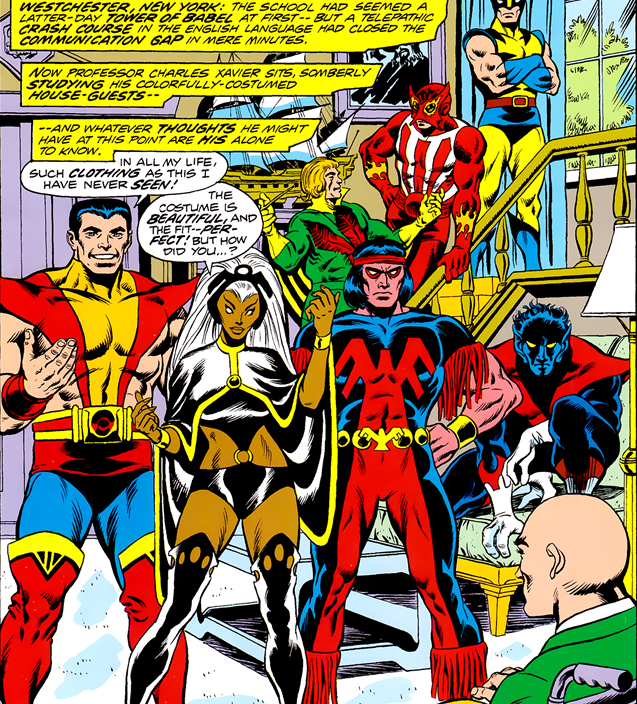
This issue also aimed to explain as to why the X-Men were absent in the last five years which turned out to be because they were abducted and stashed away in the island Krakoa during a mission to find another mutant. Only Cyclops was able to survive the ordeal and return to the Xavier School to recover and heal. Meanwhile, Professor X began recruiting across different parts of the world. For someone strictly wheelchair-bound, I have no idea how he is able to go about traveling, but hey, an excusable technicality. It was a montage of scenes, anyway. Perhaps the professor had some help around who never got to appear in the pages themselves. So in this issue, we get the appearances of Thunderbird (a new character at this point) and Sunfire which are two mutant characters I never really cared for because I hardly know them, so I'm going to purposefully skip them and talk about the four other ones I have varying degrees of affection for. 

First, we have Kurt Wagner, the teleporter otherwise known as Nightcrawler. He was being chased around by an angry mob who are trying to kill him when Professor X put a stop to it. He then made a promise to help Kurt figure out some things about his lineage and ability, but all Kurt wants to be at this point is to be normal which was perfectly understandable but the professor was quick to challenge his concept of normalcy. Intrigued and probably with nowhere else to go or anyone else willing to take him in, Kurt agrees to come with him.


Next we have Wolverine who already made his first appearance in The Incredible Hulk #181, and therefore a recognizable interesting character for the readers. In this issue, it was shown that he had been working for the Canadian government when Professor X wheels in the office to recruit him, making a pretty convincing argument as far as Wolverine is concerned. One of the bureaucrats tried to stop him but not one to nurse any fondness for authority figures, Wolverine latches out and threatens him not to get in the way. 


Professor X makes a stop to meet up with Banshee who cheerily went along for the ride without much coaxing. Professor X gets to Kenya, East Africa to encounter a self-fashioned goddess, Ororo Munroe who at first thought that the wheelchair-bound bald man was offering a ridiculous proposition, seeing as she didn't feel like living the comfortable lifestyle she has grown accustomed to. However, Charles Xavier knows exactly what to say and says things so poetically that Ororo was eventually swayed.


Next, we have sweet Peter Rasputin of Russia who demonstrates his mutant strength as he saves a girl from being ran over by a tractor. I thought it was interesting that of all the recruits, he was the only one shown to use his abilities to rescue someone and that alone has made him automatically endearing to me especially when he began to contemplate about what Professor X tells him next. This is a guy who genuinely wants to help people when he knows he has the tools to do it, and is only reluctant because he has loved ones to leave behind. His family is very supportive which made it easy for him to make his decision to join the professor and see what else he can offer the world.


So we throw in Thunderbird and Sunfire (who came off as an arrogant prick later on), and we get the new X-Men!

Cyclops later arrives to explain their mission which is to save the original X-Men from the island of Krakoa. The rest of the pages showed that these new members are not that eager to work with one another (cough, Sunfire, cough) but they generally try to form some kind of teamwork anyway as they navigated through the mysterious island where Marvel Girl, Havok, Lorna Dane, Angel and Iceman have been held captive. After finding out that the mutant the original team has been looking for turns out to be the island itself (and the fact that Krakoa has been feeding on their energies for some time now), the new guys decided to fight the wretched creature together with the help of the professor's telepathic aid. The battle was more difficult than they imagined and as soon as they made their escape, they realized that the plane can only carry a minimum amount of passengers. Now the thirteen X-Men have to decide who is going to get left behind first. 

And this is where the issue gets cut short. Now, I already know what is going to happen next since these events will be once again tackled upon in the House of M-aftermath story, Deadly Genesis which I'll be reading in May. There's a rather wicked secret about this, and boy, it's going to be a doozy one. I think I won't talk about that here and would instead discuss it on my review for Deadly Genesis. The revelation is a rather game-changer for certain characters. I'm getting excited just thinking about it now.

Overall, Giant-Size X-Men is a worthy read not only because of posterity but also because it introduced four X-Men characters who will stick around and garner their own respective fanbase throughout the years. This issue also marks the beginning of the Claremont era.


RECOMMENDED: 9/10

Tuesday, April 21, 2015

The X-Men #1 by Stan Lee and Jack Kirby [1963]

I've been gone for quite some time, I know, but not because I was slacking off. I merely had to finish reviewing some novels, and the last issues of three New 52 Batman titles in the meantime; but all the while looking for online copies of certain classics from Claremont's The Uncanny X-Men run, and the very first Stan Lee debut issue. It took me only a few days to locate downloadable sources which are simply glorious. 

So in the last two weeks of April I'll be reading and reviewing six storylines, two of which are this debut story and the Giant-Size relaunch, while the rest are as follows: The X-Tinction Agenda (issues #270-272), The Trial of Magneto (#200), Fatal Attractions (UXM #304, X-Men vol 2, #25), and Legion Quest (UXM #319-320, X-Men vol. 2, #40-41). It's worth noting that both X-Tinction and Fatal Attractions also happen in several other X-titles but I'm only choosing to read and review the key issues from The Uncanny X-Men and X-Men volume 2 run (the latter of which is for very Cherik reasons, naturally).


Take a walk with me in the silver-age memory lane with Stan Lee's very first issue of The X-Men illustrated by one of Marvel's holy trinity Jack Kirby. It's only right to include this issue in my roster after all, considering its significance, posterity-wise. This was really the first time I read it again since I was...in high school, I think, and its simple sixties charm hasn't dimmed for me at all, not one bit. Featuring the original five (Cyclops, Marvel Girl, Iceman, the Angel, and Beast) led by the powerful telepath Professor X, The X-Men  debuted as the 'strangest super-heroes of all." Clearly, a lot more eccentric than the Fantastic Four and the Avengers combined whose title runs are comparably more interesting. Most probably, I think. This is just the first issue and whatever makes the X-Men distinct and special nowadays hasn't been captured yet. Of course, the Chris Claremont era basically defined what the X-Men are, but we still owe it to Stan Lee for creating these characters in the first place. And they are absolutely an astonishing hoot in this debut.


The issue opens with a surly bald man hanging around by the window sill, alone in his private thoughts when he suddenly (and loudly telepathically) summoned his students so they can get some practice. Then came four boys with the youngest of them only at sixteen (Bobby a.k.a Iceman) who were already in their garish yellow uniforms upon entering the professor's room, ready to test out their unique abilities, these so-called "mutant" powers which we find very soon enough are fairly awesome as we spent an ample amount of pages with demonstrations of each of these boys' capabilities. The most appropriate adjective I would describe everything about this issue would be DORKY. The entirety of it all is just hilarious and oddly endearing in some places. Something about it just tickles me especially the awkward moments in between such as this panel with Angel and Cyclops politely yet sweetly trying to accommodate their dear old mentor with his reclining chair while said mentor sort of looks like he was drawn to look as if he would rather be elsewhere (preferably on a beach with his lover, Magneto, but I digress).


I'm giggling throughout the next pages of their "practice" as the professor purposefully does not even talk aloud but rather continues to communicate telepathically, justifying that it's also part of the training regimen but at this point it feels as if this frowning bald man just doesn't want to make any effort to open his mouth and would rather just sit down and watch the dorks almost successfully, sort of but not really attack and kill each other with their dangerous powers. This monotonous excitement was cut short when the professor brings the good news of acquiring another mutant to become a student in where I assume is a reclusive place (seriously, where is this school located?) Also, Iceman looks fucking ridiculous. He literally looks like a cheaply-made snowman. It's a bit distracting especially since he's wearing goddamn boots. Wouldn't the footwear stick to his frozen feet? Anyway, after a rather seamless transition of the Professor now sitting on a wheelchair in the next panel (I'll just assume Angel and Cyclops once again politely yet sweetly carried him and placed him there), they resume their 'normal' looks to go meet the lady, aiming not to scare her off. But Beast is quite the perv, calling her names like "gorgeous", "doll", "sweetheart" and even trying to peck her cheek out of goddamn nowhere. So...basically acceptable sixties behavior, I guess.


But Jean Grey is not your average lady. She's a telekenetic who can lift things and even a hefty man like Beast is no exception. After he outright attempts to affectionately molest her, she responds by dismissing Angel's chivalrous comments of trying to defend her honor, by casually suspending Beast with mind power alone, demonstrating to the boys that she is not some helpless damsel they can just touch and fondle when they feel like it. She lets him hover around in the air for a bit before she mercilessly brings him down to a sofa. Beast should consider himself warned at that point. Good for Jeannie. Again, I'll just assume that the professor simply did not give a fuck since he did not even react to any of this. He literally looks zoned out during this issue. And I'm just going to put it out there that it's because he was thinking about what Magneto is up to right now which, case in point, transitions to said super-villain as soon as the professor explains to Jean that there are evil mutants out there who are hell-bent on world domination. So right after that display of mildly amusing sixties sexism aside, the next panels now featured some hilarity concerning Magneto and the military and all that metal. The most impressive feat of which for me is the fact that Magneto can magnetize dust particles, and he then wrote the soldiers some love-me notes in the clear blue sky:


Now any respectable super-villain who can write his name in beautiful calligraphy like that using only dust particles is someone worth taking seriously, do you hear me? Magneto means serious biz. Y'all better surrender or he'll write another threatening letter..in CURSIVE WRITING!


Meanwhile, Jean Grey puts on her costume while the boys, from the corner of the room, watch her admire herself in a mirror, which begs the question: How long have they been there and did they watch her change clothes the entire time? Jeannie caught them in the act and Beast lamely makes an excuse when thankfully Professor X summons them to inform them on the attack from the previous scenes. Now, I assume that the X-Men haven't been training long enough for any sort of mission in the foreseeable future but the Professor I guess, definitely, if not quite literally, wants to throw them in a baptism of fire, including token-girl Jean Grey who JUST GOT THERE. 

"Well, sweetheart, since you had the costume on anyway, you might as well join the suicide mission, whatever, seeing as you can also lift things and stuff," chimes the professor nonchalantly.

Also, the professor neglectfully fails to mention that the kids will be meeting a man he has known for a long time (realistically, the Xavier-Magneto connection love affair hasn't been made canon yet) but let's just say he recklessly just sent away some youngsters who are very much green and ill-equipped to take on his murderous ex-boyfriend without even bothering to inform the powers of the foe they were going to face. And how do they react to this development? Well, Bobby was thrilled:


First off, "Yaybo!" should make a comeback. Am I the only one who thinks this is a timeless expression that must be utilized in every day life? Second of all, Bobby, you know what would help you get ready faster? Not put on goddamn boots because, really, how is that helping you walk better? Or maybe Bobby just wants to wear the uniform of his teammates even if it's just the footwear so he could still feel like he belongs in the group which would be heartbreaking if that is really the case then. 

So then they arrived at the scene of monstrosity (after the Professor flies them in his own private plane using his mind powers--which begs the question: can he not just will himself to walk if he is powerful enough to keep a massive aircraft afloat?). The kids then encountered Magneto for the first time. Pretty amazingly illustrated fight scenes happen as Magneto tries his darndest best to incapacitate the X-Men and almost succeeds too but then Cyclops cleverly dug a hole using his solar beam or something which enabled them to escape underground..or something. I'm really not taking anything about this issue seriously even though it's totes fun and charming all the way. 


Especially Magneto, who refers to himself in the third person like this:

*snorts* "Miraculous" Magneto...yeah, I bet that's Charles' pet name for him in the bedroom.

Overall, an uncannily entertaining debut issue. Personally, if you can't read the original run for yourselves, I recommend everyone to listen instead to the Danger Room podcast where the guys made it their personal mission to review each issue of the X-Men from the Stan Lee era. They also provided scintillating commentary along the way as they ask the hard questions concerning the subtlest loopholes in the narrative, characterizations and overall wackiness of the sixties run, all the while enjoying themselves with the content. I know I just did.

RECOMMENDED: 8/10

Thursday, April 2, 2015

Magneto Testament by Greg Pak

"My name is Max Eisenhardt. To whoever finds this, I'm sorry because I'm dead and it's now up to you. Tell everyone who will listen. Tell everyone who won't. Please don't let this happen ever again."
This was a letter written by a Jewish teenage boy inside the Nazi concentration camps in Auschwitz, Germany where he was one of the designated Sonderkommando who were laborers in the crematoria which is possibly the most degrading and sickening occupation ever created during the second World War. They were the ones who had to burn the bodies of fellow Jewish prisoners after various executions (usually in gas chambers), and the most upsetting of which has to be when they had to cremate mass graves. This young man had lost his family during a firing squad which he was the only survivor of, and while at camps he spent his entire time there trying to save Magda, a gypsy girl he went to school and fell in love with. Her survival has given him more hope to live for than his own.


Max Eisenhardt ultimately endures the horrors of the Nazi regime, thanks to his timing, resourcefulness and patience, but he was no longer a whole person after those wretched and traumatic experiences either, and this fearful and abused teenage boy eventually hardens into a man who now calls himself Erik Lehnsherr, otherwise known as the mutant revolutionist, Magneto, leader of the Brotherhood of Mutants. Written by Greg Pak (whose only work I have ever encountered was DC New 52's Batman-Superman) and illustrated by Carmine DiGiandomenico, MAGNETO TESTAMENT is a rather harrowing examination of the dark forces that shaped the boy called Max Eisenhardt into something deliberately extraordinary years after. Composed of five chapters and tons of research about the accounts written on the events within Nazi prison camps, Magneto Testament included some of the most depressing and at times intensely moving moments of what it must have been like for someone of young Magneto's lineage to grow up during one of the darkest periods in human history.

I think this was the first time in X-Men canon that a writer has attempted to expound in narrative detail the terrible things a young Magneto had to undergo during such a criminally racist time when hatred and violence against the Jewish people were so disgustingly rampant that anyone who belonged to such a troubled time couldn't possibly stay sane, especially someone like Max Eisenhardt who watched his loved ones perish and had to take care of the remains of total strangers whose only connection he had with was the fact that they were condemned as an unclean race lower than the average human. It's fucking gross, and reading Magneto Testament is uniquely painful because of the small brutalities explored in every issue. I would like to applaud Pak in successfully delivering a rather humane piece in this twisted coming-of-age story truly deserving of one of comics' most multifaceted and compelling villains. I think Pak captured the essence of what must have given Magento during the later years his righteous rage and motivation which in turn gave him the solid platform to stand on and justify his war against the human race. I don't exactly consider myself a Magneto apologist or full-pledged sympathizer because some of his revolutionary activities done in the name of mutant superiority can be extreme and misguided, if not tragically ironic.

But I think anyone who claims to either enjoy or despise his character has to at least understand his personal history, and it pleases me that Greg Pak has accomplished just that for his writing in Magneto Testament.

What I consider most commendable is the fact that Pak did not even focus on Max's mutation as a metal telekinetic. There are hints and manifestations of his powers across the issues, such as the ability to throw steel lances in a far distance and the fact that he unconsciously avoided bullets during that awful firing squad scene with his family. But Pak did not give any indication that young Max even knew how special and different he is which I thought was a great choice for the story because Pak opted to highlight his permeating helplessness as an innocent Jewish boy who had to witness the inhumane acts committed around him whose cycle of systematic violence he reluctantly learned to become a part of as well. His journey as a lowly laborer to eventual Sonderkommado has enabled him to get a closer look at the surrounding abyss whenever he had to drag and burn the bodies of countless gassed victims. Young Max had no other choice but to unflinchingly stare back at the hideous darkness and welcome it into his personal space if he ever hopes to overcome it.

As rich as the stomach-lurching scenes were for this comic book, it has to be the tiniest things that made me tear up. One of them was this full-paged panel where Max glimpsed through a room filled entirely with eyeglasses. It literally made me put down what I was reading as I closed my eyes and willed myself to breathe normally again. There was just something about it that struck me in the most visceral sense. It was so damn visually painful and inexplicably so. Even now I'm not sure why it emotionally wounded me when there are many scenes in the comic book which are more brutal and disheartening to look at. I suppose it truly is this small kind of horrific imagery that is seemingly inconsequential and mundane that left a rather huge impact on me.


As depressing as everything is about Magneto Testament, there were impressive moments of light and sweetness concerning Max's feelings for the girl Magda and his determination to save her and get her out alive. From what I know in the canon, they eventually get married and have a daughter named Anya but Pak did not add this piece of canon information for his story which was okay because reading about a hopeful Max whose devotion and concern for a girl he barely knew was so heartbreakingly simple yet moving to watch unfold. It was enough for me to cling onto. I think my emotional investment for them was particularly high because I know what was going to happen to them after the Nazis were defeated. For this key event, Chris Claremont (who was the one who gave Magneto the Holocaust survivor background thirty years ago) touched upon it in the third volume of Excalibur, issue #6 but in case you're interested to know more about it, let me briefly talk about it here if you don't mind more spoilers.

Both Erik (this is Magneto's latest name in the comics these days) and Magda escaped the camps and are more than eager to start a new life together with their daughter but a commotion happens when a bunch of Nazi sympathizers tracked them down along with other Jewish people. These assholes burned down the apartment complex where Anya was sleeping and she was trapped as Erik couldn't get her out in time. Angered beyond reprieve, his child's death was the catalyst that brought out Erik's mutant powers to the surface and he proceeds to kill them using magnetism and metal telekinesis. Magda witnessed this and called him a monster, fearing he will endanger the unborn twins in her womb she never got to tell him about. These twins eventually grow up as mutants themselves named Scarlet Witch and Quicksilver, and they were reunited with their father somewhere along the way though it took some time for either parties to realize that they were family.

But for now, here in Magneto Testament, we have young Max and Magda clinging onto their young, blossoming love at a time a happily-ever-after doesn't seem to be possible, blissfully unaware that their cavalry has just began.

In a nutshell, Magneto Testament is a searing and sublime tale about the ugly crudeness that human beings are capable of committing on one another, particularly against a minority they perceive as inferior; and how one boy's quest for survival turns him into an avenging force of nature once he becomes a man fully capable of bending worlds to his will in the name of justice he was long denied of. In a final act of redemption, the letter he wrote at the camps as a boy eventually finds a way back to him, symbolizing and affirming the truth that it is ultimately up to him after all to ensure that another Holocaust does not come to pass ever again.

This is duly recommended to both X-Men fans and comic book aficionados, especially if you're generally interested in works of fiction based on the horrors of Holocaust. I think this comic book really dealt with the events as sensitively as it could and truly delivered a magnificent Magneto-centered parable at its core.


RECOMMENDED: 9/10