Thursday, April 23, 2015

The Uncanny X-Men issue #200 "The Trial of Magneto"

At this point in Chris Claremont's era--the late eighties, to be exact--things have been more complex than the usual for The Uncanny X-Men. Two iconic events have just come to pass (The Dark Phoenix Saga, issues #101-108, and Days of Future Past, issues #141-142), while certain relationships have been tested, abandoned or newly-formed among our heroes. With Jean Grey dead and gone, Scott Summers leaving the team to try and have a normal life with his now-pregnant wife Madelyne Pryor, as well as with the inclusion of the youngest member Kitty Pryde and Jean and Scott's alternate-universe-daughter Rachel Summers--something's gotta give, that's just a fact.

Add the whole 'anti-mutant' sentiment becoming more steadily rampant, and a Professor X who had just been beaten up by mutantphobes and is now about to die; and Rachel Summers becoming a new Phoenix receptor--well, it's only sensible that messy clusterfucks of only the X-Men proportion are unavoidable. Seriously, y'all should pick up Claremont's 70's-80's run because these are just some of the classic and notable storylines that helped sealed his era as the most definitive run of the X-Men.

Issue #200 released on the first day of December 1985 marks a rather eventful moment in the X-Men history, given its numerical importance, and it's a double-sized issue running on forty-one pages of thrilling action, drama and a climactic conclusion. 

In the context of all the aforementioned things in my introductory paragraph, things apparently can get shittier and this happened during a Holocaust Memorial occasion where Kitty Pryde and Magneto himself were attendees. Cue Mystique and some evil mutants wreaking some ill-fated havoc, and the apprehension of human authorities over the place where Magneto (who has chosen to reform, albeit that new unfortunate ugly purple costume--who knew not being a super-villain anymore would also mean losing his fashion sense) basically surrenders himself, claiming its time to face the music and pay for his past transgressions. Hence, the momentous The Trial of Magneto began.

This issue touched upon on some finer points concerning Magneto's character that I enjoyed being examined and analyzed. Claremont is not only credited for giving Erik Lehnsherr (Magnus, Max Eisenhardt) the personal backstory of being a Holocaust survivor, he is also responsible for fleshing out this former cookie-cutter villain of the sixties into a full-pledged riveting character readers care about and often even root for, whose internal moral struggle to lead or destroy has always been the driving force both for the noble and atrocious actions he has committed throughout his years in the active role and service of being a mutant avenger to some and an uncompromising terrorist to many. Magneto is not merely some comic book villain to hate; he's somebody you can understand and sympathize with especially for this specific timeline of Claremont's run where we get to see him acknowledge the error of his ways. Before this trial in front of the International World court with five judges appointed by different governments across the world, Magneto's road to redemption began much earlier on and arguably most prominent when he had just prevented Rachel Summers from murdering Professor X's assailants in the previous issues or so. 

He argued that he had tried rage and vengeance and it only cost the lives of thousands of mutants that were rallied against and prosecuted all because his stand as Magneto actually contributed more to the humans' blatant hatred and ignorance of their kind. Erik Lehnsherr simply wanted to try another way now, and so he vowed to obey whatever the International World court's decision will be. Coming to his defense during the trial are Gabrielle Haller, Kitty Pryde and Charles Xavier. Meanwhile, the Fenris twins (mutants who have a grudge against Magneto) are blackmailing the X-Men by committing crimes against humans and crediting their acts of destruction to them. And since the human population at that time can no longer tell the difference between the X-Men and the evil mutants, they naturally called for the blood of any mutant they can string up and execute on the spot. With the X-Men preoccupied by this sour development, Scott Summers--who had been forced to come back previously even after making a promise to his wife Madelyne that his retirement from crime-fighting is permanent--faces an awkward situation, all the while suspicious about his former mentor, Professor X, who is grasping at the straws since his powers are weakening more and more each day, yet refuses help or admittance of his pending mortality. In addition, Madelyne is about to go on labor and Kitty Pryde realizes her eyesight is failing her and she might need to get prescription glasses. 

Basically, this issue is filled with personal tragedies, big and small, and in the heart of it all is Magneto:

I really love this issue. It was stirring, powerful and well-paced. There are great moments of dialogue and confrontations in the pages that kept me turning one after the next, all the while being thoroughly excited and dreadful for all the situations overlapping and connecting with each other especially once we reached the climax of the story. The altercation between the Fenris twins and the X-Men crash-lands into the court, interrupting the trial, and shit just hits the fan in the most alarming rate. The heroes and the villains battle it on as Magneto tries and succeeds in not killing the Fenris sibs himself which truly spoke to how much of a changed man he is. Sure, he made that grand speech I posted above but it was truly this single act of compassion that demonstrated the sincerity of his redemption. And his long-time friend and adversary has acknowledged this himself in a scene that utterly destroyed me. My Cherik radar is literally hyperventilating!

In the middle of an explosion underground, the only person Erik cared to save was Charles and he pulls him out to safety and into a garden of all places where the two estranged friends have an honest and moving conversation about second chances.

While Charles is more than ready to happily die in Erik's arms, knowing that he's leaving Erik in a good place, his alien cohort Lilandra appears and promises to save Xavier, much to everyone's relief. She had to take him away though which meant that he'll be gone for a while. Regardless, I'm happy that these two dorks have once again made up. There could have been a kiss in there somewhere too (observe that one panel) but they were sadly interrupted, much to my eternal dismay. Now I don't think Erik even asked Charles for forgiveness but the professor willingly gives it anyway, even a chance for Erik to absolve himself some more by accepting the responsibility of leading the X-Men in Charles' absence. What Charles and Erik have is a cycle of screw-ups and hurt feelings (NOT AN EXAGGERATION; no one fights and tries to destroy each other's love and faith in one another like Cherik) but ultimately theirs is a relationship about growth and forgiveness, of dreams and principles. It's a strong connection formed ages ago that could never be severed which is why Erik always come back to Charles like this (to the tune of Sara Bareilles' Gravity), and why Charles unquestionably gives him another fair chance because the truth is that even after all that ocean of death and violence between them, Charles still believes that Erik's inherent goodness will prevail. TRUE LOVE ALWAYS DOES.
Erik: "Suppose I fail and betray your dream."

Charles: "Our dream. And we'll never know if you don't try."

Did you hear that, Erik? Charles still includes you in his goals of the future even though you can be such a dickhead and often forget to include him in yours. Not even Shakespeare can count the ways of how much Charles Xavier loves Erik Lehnsherr. For me, the true testament of how much you love a person is when you want them to be standing next to you when all your dreams come true and no other friendship and unrequited romance exemplify this than Cherik. So we end this masterful issue with Erik swearing, Mouline-Rouge style (That Come What May line was simply asking for that comparison) that he will try to be a better man for Charles Xavier. 

I swear, one of these days, Erik will actually fulfill that promise.


RECOMMENDED: 10/10

Wednesday, April 22, 2015

Giant-Size X-Men #1 by Len Wein and Dave Cockrum [1975]

Around the 1970's, Marvel stopped publishing new X-Men stories after issue #93 and instead spent time reprinting past issues. It's almost comparable to Doctor Who being gone in television in the UK since 1996 and only came back around 2005. 

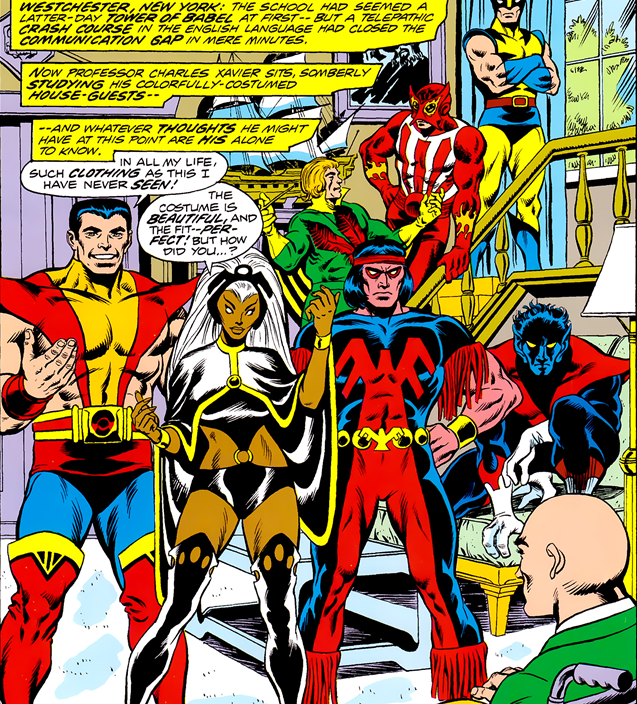
Luckily, it only took five years before Marvel decided to publish a new story. Hence the sixty-eight paged Giant-Size X-Men #1 which was written by Len Wein and illustrated by Dave Cockrum who also served as its co-author. This was an important release because not only did it mark the return of the strangest super-heroes of all in comics for some fresh material, it was also the same issue that served as a link between the old team composed of the core four members since its debut in the sixties: Cyclops, Marvel Girl, Iceman, Angel (minus Beast who left some time during the run) plus recruits, Havok and Lorna Dane, and that of the new ones as featured in the cover.

Afterwards, publications for The Uncanny X-Men run resumed again with issue #94 which, of course, also finally began the sixteen-year career of one Chris Claremont, who was fated to define and turn the X-Men as one of the most formidable and widely successful Marvel titles to ever been in print. That was only possible because this contributing piece written by Len Wein and Dave Cockrum opened the doors for that, since they had wanted Claremont on the writing board themselves and therefore helped with the transition. It's inarguable that without the launch of Giant-Size X-Men #1, we may never have gotten to Claremont's X-Men which is a literary cruelty of the highest order, in my opinion.

This issue also aimed to explain as to why the X-Men were absent in the last five years which turned out to be because they were abducted and stashed away in the island Krakoa during a mission to find another mutant. Only Cyclops was able to survive the ordeal and return to the Xavier School to recover and heal. Meanwhile, Professor X began recruiting across different parts of the world. For someone strictly wheelchair-bound, I have no idea how he is able to go about traveling, but hey, an excusable technicality. It was a montage of scenes, anyway. Perhaps the professor had some help around who never got to appear in the pages themselves. So in this issue, we get the appearances of Thunderbird (a new character at this point) and Sunfire which are two mutant characters I never really cared for because I hardly know them, so I'm going to purposefully skip them and talk about the four other ones I have varying degrees of affection for. 

First, we have Kurt Wagner, the teleporter otherwise known as Nightcrawler. He was being chased around by an angry mob who are trying to kill him when Professor X put a stop to it. He then made a promise to help Kurt figure out some things about his lineage and ability, but all Kurt wants to be at this point is to be normal which was perfectly understandable but the professor was quick to challenge his concept of normalcy. Intrigued and probably with nowhere else to go or anyone else willing to take him in, Kurt agrees to come with him.


Next we have Wolverine who already made his first appearance in The Incredible Hulk #181, and therefore a recognizable interesting character for the readers. In this issue, it was shown that he had been working for the Canadian government when Professor X wheels in the office to recruit him, making a pretty convincing argument as far as Wolverine is concerned. One of the bureaucrats tried to stop him but not one to nurse any fondness for authority figures, Wolverine latches out and threatens him not to get in the way. 


Professor X makes a stop to meet up with Banshee who cheerily went along for the ride without much coaxing. Professor X gets to Kenya, East Africa to encounter a self-fashioned goddess, Ororo Munroe who at first thought that the wheelchair-bound bald man was offering a ridiculous proposition, seeing as she didn't feel like living the comfortable lifestyle she has grown accustomed to. However, Charles Xavier knows exactly what to say and says things so poetically that Ororo was eventually swayed.


Next, we have sweet Peter Rasputin of Russia who demonstrates his mutant strength as he saves a girl from being ran over by a tractor. I thought it was interesting that of all the recruits, he was the only one shown to use his abilities to rescue someone and that alone has made him automatically endearing to me especially when he began to contemplate about what Professor X tells him next. This is a guy who genuinely wants to help people when he knows he has the tools to do it, and is only reluctant because he has loved ones to leave behind. His family is very supportive which made it easy for him to make his decision to join the professor and see what else he can offer the world.


So we throw in Thunderbird and Sunfire (who came off as an arrogant prick later on), and we get the new X-Men!

Cyclops later arrives to explain their mission which is to save the original X-Men from the island of Krakoa. The rest of the pages showed that these new members are not that eager to work with one another (cough, Sunfire, cough) but they generally try to form some kind of teamwork anyway as they navigated through the mysterious island where Marvel Girl, Havok, Lorna Dane, Angel and Iceman have been held captive. After finding out that the mutant the original team has been looking for turns out to be the island itself (and the fact that Krakoa has been feeding on their energies for some time now), the new guys decided to fight the wretched creature together with the help of the professor's telepathic aid. The battle was more difficult than they imagined and as soon as they made their escape, they realized that the plane can only carry a minimum amount of passengers. Now the thirteen X-Men have to decide who is going to get left behind first. 

And this is where the issue gets cut short. Now, I already know what is going to happen next since these events will be once again tackled upon in the House of M-aftermath story, Deadly Genesis which I'll be reading in May. There's a rather wicked secret about this, and boy, it's going to be a doozy one. I think I won't talk about that here and would instead discuss it on my review for Deadly Genesis. The revelation is a rather game-changer for certain characters. I'm getting excited just thinking about it now.

Overall, Giant-Size X-Men is a worthy read not only because of posterity but also because it introduced four X-Men characters who will stick around and garner their own respective fanbase throughout the years. This issue also marks the beginning of the Claremont era.


RECOMMENDED: 9/10

Tuesday, April 21, 2015

The X-Men #1 by Stan Lee and Jack Kirby [1963]

I've been gone for quite some time, I know, but not because I was slacking off. I merely had to finish reviewing some novels, and the last issues of three New 52 Batman titles in the meantime; but all the while looking for online copies of certain classics from Claremont's The Uncanny X-Men run, and the very first Stan Lee debut issue. It took me only a few days to locate downloadable sources which are simply glorious. 

So in the last two weeks of April I'll be reading and reviewing six storylines, two of which are this debut story and the Giant-Size relaunch, while the rest are as follows: The X-Tinction Agenda (issues #270-272), The Trial of Magneto (#200)Fatal Attractions (UXM #304, X-Men vol 2, #25), and Legion Quest (UXM #319-320, X-Men vol. 2, #40-41). It's worth noting that both X-Tinction and Fatal Attractions also happen in several other X-titles but I'm only choosing to read and review the key issues from The Uncanny X-Men and X-Men volume 2 run (the latter of which is for very Cherik reasons, naturally).


Take a walk with me in the silver-age memory lane with Stan Lee's very first issue of The X-Men illustrated by one of Marvel's holy trinity Jack Kirby. It's only right to include this issue in my roster after all, considering its significance, posterity-wise. This was really the first time I read it again since I was...in high school, I think, and its simple sixties charm hasn't dimmed for me at all, not one bit. Featuring the original five (Cyclops, Marvel Girl, Iceman, the Angel, and Beast) led by the powerful telepath Professor X, The X-Men  debuted as the 'strangest super-heroes of all." Clearly, a lot more eccentric than the Fantastic Four and the Avengers combined whose title runs are comparably more interesting. Most probably, I think. This is just the first issue and whatever makes the X-Men distinct and special nowadays hasn't been captured yet. Of course, the Chris Claremont era basically defined what the X-Men are, but we still owe it to Stan Lee for creating these characters in the first place. And they are absolutely an astonishing hoot in this debut.


The issue opens with a surly bald man hanging around by the window sill, alone in his private thoughts when he suddenly (and loudly telepathically) summoned his students so they can get some practice. Then came four boys with the youngest of them only at sixteen (Bobby a.k.a Iceman) who were already in their garish yellow uniforms upon entering the professor's room, ready to test out their unique abilities, these so-called "mutant" powers which we find very soon enough are fairly awesome as we spent an ample amount of pages with demonstrations of each of these boys' capabilities. The most appropriate adjective I would describe everything about this issue would be DORKY. The entirety of it all is just hilarious and oddly endearing in some places. Something about it just tickles me especially the awkward moments in between such as this panel with Angel and Cyclops politely yet sweetly trying to accommodate their dear old mentor with his reclining chair while said mentor sort of looks like he was drawn to look as if he would rather be elsewhere (preferably on a beach with his lover, Magneto, but I digress).


I'm giggling throughout the next pages of their "practice" as the professor purposefully does not even talk aloud but rather continues to communicate telepathically, justifying that it's also part of the training regimen but at this point it feels as if this frowning bald man just doesn't want to make any effort to open his mouth and would rather just sit down and watch the dorks almost successfully, sort of but not really attack and kill each other with their dangerous powers. This monotonous excitement was cut short when the professor brings the good news of acquiring another mutant to become a student in where I assume is a reclusive place (seriously, where is this school located?) Also, Iceman looks fucking ridiculous. He literally looks like a cheaply-made snowman. It's a bit distracting especially since he's wearing goddamn boots. Wouldn't the footwear stick to his frozen feet? Anyway, after a rather seamless transition of the Professor now sitting on a wheelchair in the next panel (I'll just assume Angel and Cyclops once again politely yet sweetly carried him and placed him there), they resume their 'normal' looks to go meet the lady, aiming not to scare her off. But Beast is quite the perv, calling her names like "gorgeous", "doll", "sweetheart" and even trying to peck her cheek out of goddamn nowhere. So...basically acceptable sixties behavior, I guess.


But Jean Grey is not your average lady. She's a telekenetic who can lift things and even a hefty man like Beast is no exception. After he outright attempts to affectionately molest her, she responds by dismissing Angel's chivalrous comments of trying to defend her honor, by casually suspending Beast with mind power alone, demonstrating to the boys that she is not some helpless damsel they can just touch and fondle when they feel like it. She lets him hover around in the air for a bit before she mercilessly brings him down to a sofa. Beast should consider himself warned at that point. Good for Jeannie. Again, I'll just assume that the professor simply did not give a fuck since he did not even react to any of this. He literally looks zoned out during this issue. And I'm just going to put it out there that it's because he was thinking about what Magneto is up to right now which, case in point, transitions to said super-villain as soon as the professor explains to Jean that there are evil mutants out there who are hell-bent on world domination. So right after that display of mildly amusing sixties sexism aside, the next panels now featured some hilarity concerning Magneto and the military and all that metal. The most impressive feat of which for me is the fact that Magneto can magnetize dust particles, and he then wrote the soldiers some love-me notes in the clear blue sky:


Now any respectable super-villain who can write his name in beautiful calligraphy like that using only dust particles is someone worth taking seriously, do you hear me? Magneto means serious biz. Y'all better surrender or he'll write another threatening letter..in CURSIVE WRITING!


Meanwhile, Jean Grey puts on her costume while the boys, from the corner of the room, watch her admire herself in a mirror, which begs the question: How long have they been there and did they watch her change clothes the entire time? Jeannie caught them in the act and Beast lamely makes an excuse when thankfully Professor X summons them to inform them on the attack from the previous scenes. Now, I assume that the X-Men haven't been training long enough for any sort of mission in the foreseeable future but the Professor I guess, definitely, if not quite literally, wants to throw them in a baptism of fire, including token-girl Jean Grey who JUST GOT THERE. 

"Well, sweetheart, since you had the costume on anyway, you might as well join the suicide mission, whatever, seeing as you can also lift things and stuff," chimes the professor nonchalantly.

Also, the professor neglectfully fails to mention that the kids will be meeting a man he has known for a long time (realistically, the Xavier-Magneto connection love affair hasn't been made canon yet) but let's just say he recklessly just sent away some youngsters who are very much green and ill-equipped to take on his murderous ex-boyfriend without even bothering to inform the powers of the foe they were going to face. And how do they react to this development? Well, Bobby was thrilled:


First off, "Yaybo!" should make a comeback. Am I the only one who thinks this is a timeless expression that must be utilized in every day life? Second of all, Bobby, you know what would help you get ready faster? Not put on goddamn boots because, really, how is that helping you walk better? Or maybe Bobby just wants to wear the uniform of his teammates even if it's just the footwear so he could still feel like he belongs in the group which would be heartbreaking if that is really the case then. 

So then they arrived at the scene of monstrosity (after the Professor flies them in his own private plane using his mind powers--which begs the question: can he not just will himself to walk if he is powerful enough to keep a massive aircraft afloat?). The kids then encountered Magneto for the first time. Pretty amazingly illustrated fight scenes happen as Magneto tries his darndest best to incapacitate the X-Men and almost succeeds too but then Cyclops cleverly dug a hole using his solar beam or something which enabled them to escape underground..or something. I'm really not taking anything about this issue seriously even though it's totes fun and charming all the way. 


Especially Magneto, who refers to himself in the third person like this:

*snorts* "Miraculous" Magneto...yeah, I bet that's Charles' pet name for him in the bedroom.

Overall, an uncannily entertaining debut issue. Personally, if you can't read the original run for yourselves, I recommend everyone to listen instead to the Danger Room podcast where the guys made it their personal mission to review each issue of the X-Men from the Stan Lee era. They also provided scintillating commentary along the way as they ask the hard questions concerning the subtlest loopholes in the narrative, characterizations and overall wackiness of the sixties run, all the while enjoying themselves with the content. I know I just did.

RECOMMENDED: 8/10

Thursday, April 2, 2015

Magneto Testament by Greg Pak

"My name is Max Eisenhardt. To whoever finds this, I'm sorry because I'm dead and it's now up to you. Tell everyone who will listen. Tell everyone who won't. Please don't let this happen ever again."
This was a letter written by a Jewish teenage boy inside the Nazi concentration camps in Auschwitz, Germany where he was one of the designated Sonderkommando who were laborers in the crematoria which is possibly the most degrading and sickening occupation ever created during the second World War. They were the ones who had to burn the bodies of fellow Jewish prisoners after various executions (usually in gas chambers), and the most upsetting of which has to be when they had to cremate mass graves. This young man had lost his family during a firing squad which he was the only survivor of, and while at camps he spent his entire time there trying to save Magda, a gypsy girl he went to school and fell in love with. Her survival has given him more hope to live for than his own.


Max Eisenhardt ultimately endures the horrors of the Nazi regime, thanks to his timing, resourcefulness and patience, but he was no longer a whole person after those wretched and traumatic experiences either, and this fearful and abused teenage boy eventually hardens into a man who now calls himself Erik Lehnsherr, otherwise known as the mutant revolutionist, Magneto, leader of the Brotherhood of Mutants. Written by Greg Pak (whose only work I have ever encountered was DC New 52's Batman-Superman) and illustrated by Carmine DiGiandomenico, MAGNETO TESTAMENT is a rather harrowing examination of the dark forces that shaped the boy called Max Eisenhardt into something deliberately extraordinary years after. Composed of five chapters and tons of research about the accounts written on the events within Nazi prison camps, Magneto Testament included some of the most depressing and at times intensely moving moments of what it must have been like for someone of young Magneto's lineage to grow up during one of the darkest periods in human history.

I think this was the first time in X-Men canon that a writer has attempted to expound in narrative detail the terrible things a young Magneto had to undergo during such a criminally racist time when hatred and violence against the Jewish people were so disgustingly rampant that anyone who belonged to such a troubled time couldn't possibly stay sane, especially someone like Max Eisenhardt who watched his loved ones perish and had to take care of the remains of total strangers whose only connection he had with was the fact that they were condemned as an unclean race lower than the average human. It's fucking gross, and reading Magneto Testament is uniquely painful because of the small brutalities explored in every issue. I would like to applaud Pak in successfully delivering a rather humane piece in this twisted coming-of-age story truly deserving of one of comics' most multifaceted and compelling villains. I think Pak captured the essence of what must have given Magento during the later years his righteous rage and motivation which in turn gave him the solid platform to stand on and justify his war against the human race. I don't exactly consider myself a Magneto apologist or full-pledged sympathizer because some of his revolutionary activities done in the name of mutant superiority can be extreme and misguided, if not tragically ironic.

But I think anyone who claims to either enjoy or despise his character has to at least understand his personal history, and it pleases me that Greg Pak has accomplished just that for his writing in Magneto Testament.

What I consider most commendable is the fact that Pak did not even focus on Max's mutation as a metal telekinetic. There are hints and manifestations of his powers across the issues, such as the ability to throw steel lances in a far distance and the fact that he unconsciously avoided bullets during that awful firing squad scene with his family. But Pak did not give any indication that young Max even knew how special and different he is which I thought was a great choice for the story because Pak opted to highlight his permeating helplessness as an innocent Jewish boy who had to witness the inhumane acts committed around him whose cycle of systematic violence he reluctantly learned to become a part of as well. His journey as a lowly laborer to eventual Sonderkommado has enabled him to get a closer look at the surrounding abyss whenever he had to drag and burn the bodies of countless gassed victims. Young Max had no other choice but to unflinchingly stare back at the hideous darkness and welcome it into his personal space if he ever hopes to overcome it.

As rich as the stomach-lurching scenes were for this comic book, it has to be the tiniest things that made me tear up. One of them was this full-paged panel where Max glimpsed through a room filled entirely with eyeglasses. It literally made me put down what I was reading as I closed my eyes and willed myself to breathe normally again. There was just something about it that struck me in the most visceral sense. It was so damn visually painful and inexplicably so. Even now I'm not sure why it emotionally wounded me when there are many scenes in the comic book which are more brutal and disheartening to look at. I suppose it truly is this small kind of horrific imagery that is seemingly inconsequential and mundane that left a rather huge impact on me.


As depressing as everything is about Magneto Testament, there were impressive moments of light and sweetness concerning Max's feelings for the girl Magda and his determination to save her and get her out alive. From what I know in the canon, they eventually get married and have a daughter named Anya but Pak did not add this piece of canon information for his story which was okay because reading about a hopeful Max whose devotion and concern for a girl he barely knew was so heartbreakingly simple yet moving to watch unfold. It was enough for me to cling onto. I think my emotional investment for them was particularly high because I know what was going to happen to them after the Nazis were defeated. For this key event, Chris Claremont (who was the one who gave Magneto the Holocaust survivor background thirty years ago) touched upon it in the third volume of Excalibur, issue #6 but in case you're interested to know more about it, let me briefly talk about it here if you don't mind more spoilers.

Both Erik (this is Magneto's latest name in the comics these days) and Magda escaped the camps and are more than eager to start a new life together with their daughter but a commotion happens when a bunch of Nazi sympathizers tracked them down along with other Jewish people. These assholes burned down the apartment complex where Anya was sleeping and she was trapped as Erik couldn't get her out in time. Angered beyond reprieve, his child's death was the catalyst that brought out Erik's mutant powers to the surface and he proceeds to kill them using magnetism and metal telekinesis. Magda witnessed this and called him a monster, fearing he will endanger the unborn twins in her womb she never got to tell him about. These twins eventually grow up as mutants themselves named Scarlet Witch and Quicksilver, and they were reunited with their father somewhere along the way though it took some time for either parties to realize that they were family.

But for now, here in Magneto Testament, we have young Max and Magda clinging onto their young, blossoming love at a time a happily-ever-after doesn't seem to be possible, blissfully unaware that their cavalry has just began.

In a nutshell, Magneto Testament is a searing and sublime tale about the ugly crudeness that human beings are capable of committing on one another, particularly against a minority they perceive as inferior; and how one boy's quest for survival turns him into an avenging force of nature once he becomes a man fully capable of bending worlds to his will in the name of justice he was long denied of. In a final act of redemption, the letter he wrote at the camps as a boy eventually finds a way back to him, symbolizing and affirming the truth that it is ultimately up to him after all to ensure that another Holocaust does not come to pass ever again.

This is duly recommended to both X-Men fans and comic book aficionados, especially if you're generally interested in works of fiction based on the horrors of Holocaust. I think this comic book really dealt with the events as sensitively as it could and truly delivered a magnificent Magneto-centered parable at its core.


RECOMMENDED: 9/10

Friday, March 27, 2015

House of M by Brian Michael Bendis and Oliver Coipel

I originally intended to review all eight issues individually but due to some unforeseen time restraints IRL, I decided to simply post a single official review for its overall collection instead. And let me tell you something: writer Brian Michael Endis and artist Oliver Coipel have composed a formidable and pristine piece of comic book storytelling in the unbelievably catastrophic major event of House of M which had been dubbed ominously as "M-Day." And for a rather distressing reason at that.

M-Day not only affected X-Men's universe but also a great portion of the Marvelverse. Picking up right after the events of Planet X and Avengers Disassembled,  as well as Claremont's Excalibur III, House of M explores the turbulent effects of Wanda Maximoff's degrading mental state as the Scarlet Witch. Something just broke inside the poor woman, and she went on in a blind rampage, killing a few of the Avengers she and her twin brother Pietro (Quicksilver) have been a part of.

Because of this disaster, their father, Magneto, who had been declared officially dead to the world at large but was in truth living with Charles Xavier so they can restore Genosha together (Excalibur III) was forced out of hiding in the shadows so he can whisk her away to safety. He sought Xavier's help to cure her but in the last six months even the world's greatest telepathic mind could not mend what was so broken in Wanda's psyche.

The House of M arc is composed of a grand total of fifty-three issues, crossovering with titles such as The Uncanny X-Men, The Incredible Hulk, Fantastic Four, Iron Man, Cable and Deadpool, Spider-Man, Captain America, to name a few. However, I only decided to touch upon the major eight-issued series which contained this volume and it's been one of the most stressful and exhilarating adventure I've ever had the pleasure of reading!

What was immediately exciting about this story is the fact that the ensemble of cast featured (X-Men, the Avengers, Dr. Strange and other Marvel characters with a direct connection with either group) was gathered together for a strong purpose and whose stories were scattered and sometimes necessarily explored rather well in each issue. Writing-wise, this could have easily been clattered and confusing, but Bendis excellently divided the characters within groups and glossed over the finest details with a concise and cohesive sense of narrative and action without overwhelming the readers nor diluting the importance of these subplots. The build-up and suspense were present issue after issue, leaving readers definitely invested on what will happen next which is something I know is never always a sure route when it comes to crossover events in comics. I believe that House of M excelled in this respect, reeling in readers, weaving them into the fabric of the narrative, and untangling the seams and threads only when there is no other choice for them but to unravel. And it's quite an experience because not only do readers look forward to the climactic confrontations and resolutions, but they are also interested in the way these game-changing events have affected the characters as individuals and as a unit.

Speaking of the latter, there were clear standouts that grabbed my attention with their characterizations for this story: Peter Parker, Emma Frost, Wanda and Pietro, and Hawkeye. These characters were fascinating and a little bit heartbreaking to read about because I felt for them during their experiences during M-Day. Basically, to evade the X-Men and the Avengers, Magneto, Wanda and Pietro hide out in a new reality the Scarlet Witch created where it's the humans who are the minority and the mutants are free to do whatever they want since it's their world now. This means that every character in the Marvelverse had their lives rewritten for them, and it was later revealed that the Scarlet Witch was able to achieve this by combining her powers with Charles Xavier's whose mind she's been connected with for six months now when he was trying to mend her. The only one who seemed to recognize that it was all an illusion was Wolverine, given his overall constitution and the fact that he had been mind-wiped so many times that once he actually remembered all the events in his life in the new world Wanda created, he immediately knew something was not right. He started to seek out the other heroes with the help of this mysterious girl named Layla Miller who can somehow restore memories once she comes in contact with them. Afterwards, a race to confront House of Magnus begins.

SPOILERS EXTRAVAGANZA AHEAD!
 
 
It's a widely acceptable notion to believe that it was Magneto who orchestrated all of this. After all, he wanted mutants to rule and govern as the superior species while humankind becomes the secondary citizens of the world in return. Scarlet Witch's new world was the utopia he had always wanted and so once the heroes recovered their memories and discovered the truth, they were livid because everything about this version of reality has Magneto's propaganda written all over it. But by the last two issues, Dr. Strange had a conversation with Wanda herself while she was tending to her imaginary children and he uncovered that it was her twin brother Pietro who had begged her to "cast a spell" on everyone in Marvelverse using her mutant powers of reality-bending. He did it because Pietro had always been so viciously protective of Wanda and seeing that their own estranged father was helpless to stop the X-Men and the Avengers from taking away (or even possibly killing Wanda), he convinces his sister, whose mind is already damaged to begin with, to "give everyone their heart's desire" in a new world she would construct. And so their will be done. Scarlet Witch reached Xavier to tap his powers and unite them with hers.

Forgive me for inserting some Cherik commentary by this part of the review but I think it needs to be said. When Pietro requested that the new world will be able to give everyone's desire, this also includes the accomplishment of their own father's goals, and he is by now the sole ruler of the entire world under the House of M. Magneto is living in a clearly utopic Genosha (a place he and Charles have spent some gruelling time on during Excalibur III). However, it's worth nothing that, in this version of reality, his long-time best friend is dead. That was the price to pay for the ultimate realization of a dream he shared with the said man. And that explains why Erik Lehnsherr actually looks miserable, in spite of getting everything he desired since the beginning; a peaceful world where mutants are the majority while his family is intact. That should be suffice to explain why he was so goddamn infuriated when he found out what Pietro and Wanda did. So my question is--and please, hear this on every level--HOW WOULD ANYONE EXPECT HIM TO LIVE IN A WORLD WITHOUT CHARLES XAVIER? Add that to the list of reasons why he was angry for what the twins did. Now this is actually a plausible theory, okay? I mean, he did play house with Charles instead of informing his own children that he's not dead. It's a good thing this remains unsaid because that's just going to further piss off Pietro and Wanda. They already feel neglected as it  is and for years by their father. They don't want to hear the fact that he didn't even write, he didn't even call, but rather just straight-up eloped with his boyfriend in Genosha and continued to fake his death. YIKES.

Look at this miserable sack of sad shit. He wanted to rule the world but not without his oldest friend by his side.

Back to more serious matters: it looks like Magneto can still hurt his children worse that he already has which sucks sweaty donkey balls because he had all these heartfelt retrospection in Claremont's Excalibur III where he wants to be a better father and all that. So what the fucking fuckity fuck did you just do, Mags? Look, I get you're mad that Pietro and Wanda seem to think that a world without your boyfriend Chuck is something you desire the most, but it's not like you were ever open about that relationship with them. Also, don't be a fucking hypocrite and scold them for their arrogance because they believe they are better than everyone else. YOU GODDAMN TAUGHT THEM THAT, JERK. Clearly, this will piss off Wanda because it's not like she has any idea that Magneto has undergone some thoughtful changes in his outlook and philosophy during his stay in Gensoha with Charles. So hearing him say bullshit like that made her skin crawl.

OH, AND HE JUST KILLED PIETRO BY DROPPING AN ENTIRE INFRASTRUCTURE ON HIM.

FUCCCCCCCKKKKKKKKK!!!! Consider it a blessing that Charles is not alive to see what you have done, Erik!

So after Wanda resurrects her bro, she has every right to vehemently call out Magneto right there and then:

 
Driven to despair and already fragile and remorseful, Magneto hammers the last nail on Wanda's proverbial coffin of sanity by murdering her brother in front of her so now she makes this grand proclamation that I believe was only uttered as a whisper but with a level of apathy and reverence that would chill anyone who reads it:


And the Scarlet Witch proceeds to remake the world again, depowering almost every mutant across the world, leaving only a scattered few with their powers still intact, including some of the adult X-Men while the students of Xavier School were not even spared. Even Magneto can't even move a fucking fork. And it serves him right. Wanda's utter decimation of mutantkind made Cassandra Nova and the Sentinels laying Genosha to waste before seem like a practical joke. What Wanda Maximoff did was just...frightening and borne out of sadness and a desperation for love, just as Charles had said in the final issue of Excalibur III. All she and her brother ever wanted was a father and a family where they could be accepted and truly belong to. They tried to find these things with the Avengers and in making the world a better place--but the one person whom they wanted love and affection from the most, their own father, considered to be a terrorist and a hard man through and through, has failed to give them that, and then hurt them in ways that can never heal. And so this is Wanda lashing out for the last time, which also happened to tragically affect everyone else in the process.

At its core, M-Day just proves that the world as we know it can end not with a bang but with a whimper.

An exemplary and well-crafted tale that is briskly paced and shocking, House of M is an enduring comic book you must have on your shelf. I might get around to reading the crossover titles for this arc some time but for now I would like to focus on reading and reviewing the next chapter of this game-changing event, more specifically Deadly Genesis, Messiah Complex and Second Coming volumes. I won't be updating my X-Men reviews this holy week because I'm going on a family trip but I'll also be reading Magneto Testament which is a rather gruesome material about young Erik's time at the Nazi camps which I considered only appropriate to browse after reading this.

RECOMMENDED: 9/10


Tuesday, March 24, 2015

X-Men: Excalibur III by Chris Claremont issue #12-14


Are you all ready for this? BECAUSE I HONESTLY AM NOT.

The final arc for Chris Claremont's Excalibur III is called The Devil's Own and it runs for four issues (#11-14) which are also considered as preludes to the House of M storyline by Brian Michael Bendis (which is the next series I'll be reading the fuck out of, and you better believe it), particularly the last issue which was the finale; otherwise known as a twenty-eight paged massacre of all my shippy feelings for Charles and Erik, all bundled in one convenient package of Claremont-styled cheestastic narrative and dialogue exchanges. I've been reading nothing but Claremont since January of this year and it's hard to believe this is the very last X-Men of his I'll be perusing (until Age of Apocalypse, that is, which I scheduled during a midyear). Nevertheless, I am more than happy to end on this note. Excalibur III was sad and tragic and everything definitive in what I've always believed and cherished regarding the relationship between Professor X and Magneto. I maintain from here on out that Claremont is probably the only writer who can capture the beautiful subtleties of their friendship and baggage of losses, shame and guilt. The characterizations for their respective characters have almost destroyed me at times.

Now I have some heavy-duty investment on this last volume of this series, so my perfect rating is unbelievably based on that because I cannot force myself to be objective and detached from a story that spoke volumes to me. I will never apologize about the singular truth that I LOVE CHARLES XAVIER AND ERIK LEHNSHERR as characters and as a pairing so much. Hence, please be warned that this review contains some of the most dramatic insights I will ever publish online concerning the depths of love that I have for this uniquely devastating relationship.

Let me just warm up to that calvary. First, I'll glaze over the twelfth and thirteenth issues which is a separate plot concerning the supporting characters Callisto, Karima and Shola who decided to help out the new X-Men during an attack in New York City where they have to fight Viper and some of her allies. I thought that this plot thread was interesting enough, loaded with action, great character interaction and development, as well as a surprise twist concerning the nefarious aims of Courtney Ross, the new White Queen to the Hellfire Club, who apparently is eager to provide finance on Genosha, believing this will give her an opportunity to seize it under her control. That is a hell of a bad news for Charles and Erik who have just appointed themselves as the liberators of this island which is essentially what Excalibur III has been centered aorund.

Since her appearance in the second issue, Callisto has been consistently impressive for this. She may have some grit but there's a surprising warmth to her presence that makes her readable and fun. She's got style, a snarky attitude and tons of wonderful chemistry with almost everyone including Charles and especially with Karima and Shola. The three of them, accompanied reluctantly by the teenage teleporter Hub, are amazing as a unit, fighting the bad guys and helping the X-Men with everything they've got. These people have only known each other for a short time but they already have a sense of camaraderie together which actually isn't forced. I believe these three naturally gravitated towards one another because they want to do good and they know they can never do it alone. Their strengths and weaknesses in combat and leadership style balance together and I would love to read more about them in another title if there's ever going to be a spin-off.

Another noteworthy character is Archangel who is put in a more assertive position as he tries to lead the team of the X-Men who responded to the crisis in New York. It was nice that when all the commotion has been diverted, these heroes' actions were acknowledged by the general public. That's a sweet, touching wrap-up which seamlessly led to the much bigger story concerning Charles who has been trying to telepathically heal Wanda (Scarlet Witch and Magneto's daughter) for six months now since we last read his conversation with Erik in issue #11, but with no clear results. Desperate, he sought out the help of his old friend Stephen Strange, also known as Dr. Strange.

This is where we arrive to the momentous finale of this series which jump-starts the House of M storyline by Bendis later on.

First of all, my imagination has created the fantasy that the versions who are playing out this story are James McAvoy as Prof X and Benedict Cumberbatch as Dr. Strange, and you best leave this innocent delusion at that, okay? So let's proceed.

After Charles makes a telepathic contact with Stephen (he's still in Genosha at this point), we open issue #14 with a visit from his past, a memory lane in particular, when he used to be in the military. If this seems odd at first because we all know the professor as a pacifist, then it might make more sense if you accept his explanation that he considered himself as a shepherd rather than a soldier, whose primary aim is to find the lost flock and bring them back home to America. It was only when Stephen finally appeared when Charles realized that this was all a telepathic reminisce and that he is currently still in Genosha, tending to Wanda Maximoff's mental health. With Stephen guiding him inside the astral plane, Charles began to contemplate about the things he's been repressing for so long, and no one is as keen on repression like Charles Xavier. Check out this revealing set of panels:


In short: as Charles struggles to mend Wanda through mental contact, she herself is blocking him  through channelling scenarios from his past she knows will be able to keep him preoccupied. As the Scarlet Witch, she has the ability to bend dimensions to her will including the astral plane so it's no surprise that she can manipulate Charles to a certain extent. She's resisting his help and by exposing him to his greatest regrets via mindscape, he's rendered unable to help her recover. It's a good thing Dr. Strange was here to remind him of his current goal and not to get lost in the winding pathways of his own mistakes. Basically, Stephen wants him to recognize the crippling effect of his guilt which is what is stopping him from getting through Wanda in the first place. How can he hope to save her when he is just as lost as she is? So, aside from this free therapy session with the Sorcerer Supreme, these two also talk about Erik. A LOT. Erik, after all, is the source of most of Charles' perceived failures. Here is a rather harrowing example of that:


"I believe in him, Stephen. To the core of my being, I believe he is fundamentally a good and decent man." *sniffs* Dammit, Charles. Why do you cling so tightly on Erik's capacity to grow and change like this, to his inherent sense of goodness and light, even when you know how much darkness and chaos he has brought to the world? If our actions and choices are the things that define our lives and whether or not we are good or bad people, then Erik is definitely a complicated mixed bag of both. BUT CHARLES LOVES HIM ANYWAY. He has faith in Erik, an unshakeable one that allows him to welcome and forgive his friend so many times, no matter how rotten things get because of Magneto's unflinching dedication to his extremist ways of mutant superiority.

Why even bother, Dr. Strange inquires, loving someone so damaged who spent almost two decades of his life retaliating against his perceived tormentors, the 'inferior' homo sapiens as he, Magneto, personally deemed? And Charles' response was that all the things Erik committed later on in life was because of his experiences in the past when he only knew humanity in the darkest time of history, as a Jewish boy in a Nazi prison camp. He was tasked to haul bodies from gas chambers to the crematorium; these are people whom he may have known as neighbors, distant relatives--people who were discriminated against because they are thought to be different and therefore deserved to be oppressed. Witnessing hideous things has made him hideous but this doesn't mean he was worthy of hatred and scorn. Charles only believed someone like Erik Lehnsherr is worthy of his love because Charles is pathologically a martyr who finds relevance and joy in helping people, even to a fault. That's why these two are quite perfect for one another. Is it unhealthy in the long run? Won't they be better off without hanging onto each other since they merely go around in circles of break up, make up and break up again? Possibly. But neither of them would have made it this far if it wasn't for the fact that their friendship--even their conflicts, frustrations and disappointments--gave them purpose. Erik strives to be a better man for Charles' sake and Charles never stops believing Erik could be saved.

As much as the conversation is Erik-centric at times, this issue still delves into Charles' own psyche which was why we get these panels featuring his ex-girlfriend Gabirelle Heller whom he met around the same time as Erik back in an Israel hospital for Nazi survivors. Gaby was a catatonic patient whom Charles healed through telepathy AND THEN STARTED DATING. That is as creepy and amoral as it sounds. I'm so relieved that Charles finally owned up to that, admitting that he was guilty of taking advantage of Gaby at her weakest moment.


Being able to reconcile with that, Charles finally did something he has refused to do for so long, which is to forgive himself for being just another flawed man. See, Charles wants to believe he is always doing good because his intentions are noble most of the time but history has shown that he is just as capable of deception, secrets and detachment; inflicting indirect pain and stress on his own students which was why it makes sense that some of the X-Men have learned to trust him less lately, even Scott (Cyclops) who is more or less his surrogate son. This even soured once they found out he ran off with Magneto whom they all believed is dead. Heck, Charles even held a funeral even though they vehemently protested. It's no wonder Charles is on repression mode again, knowing he has sinned and failed his children but is far too stubborn to admit to it. He's just like Erik in that respect. Is it any wonder he wants to believe Erik can change because that means perhaps he too can repair his relationships with the ones he love? So after that reconciliation, he comes back to the present in Genosha with Erik tending to his daughter Wanda. HENCE BEGAN THE MOST HEARBREAKING 'BREAK-UP' BETWEEN THE TWO YET:

"Old patterns. Automatic responses.  This is the way it's always been between us."

NO. JUST NO. GODDAMN FUCKING NOPE, NOPE, NOPE! Also, Erik was reading The Once and Future King.


"Don't leave me, Charles!"

"I'd want to know if you're truly the man I thought you were all these years OR SIMPLY REPRESENTING THE FALSE HOPES OF MY YOUTH."

Why does this exchange remind me of this scene in X-Men: First Class otherwise known as a CRIME AGAINST THE HEART?:


LOOK AT THOSE MEN LOOKING AT EACH OTHER WITH THAT FORLORN EXPRESSION! If you're suddenly hearing the chorus to Adele's "Rolling the Deep" while reading this issue, particularly with the panels above, then don't worry, you're not alone. YOU ARE GOING INSANE AND I AM HERE TO HOLD YOUR HAND THROUGH THE MADNESS, and sing the song along with you.

I am frankly exhausted as I type this. I think I reached my Cherik quota for the day with this review. So I'm just going to leave you with this final page of issue #14 where Charles once again defends Erik by saying the cheesiest and heartwarming of justifications ever as Dr. Strange weighs in. This conversation would be even more awesome and painful if you imagine James McAvoy and Benedict Cumberbatch having it. Go on. Try it. And yes, this volume (issues #11-14) have a perfect rating for me for very subjective reasons. I will not apologize for any of them!


RECOMMENDED: 10/10